Sunscreen Tips from Your Board-Certified Dermatologist
Lawrence J. Green, M.D., FAAD
Clinical Professor of Dermatology, George Washington University School of Medicine
Past President, Montgomery County Medical Society
Dr. Green explains, in three easy steps, the best way to take care of your skin this summer. The article and infographic at the bottom can be repurposed for use with your patients.
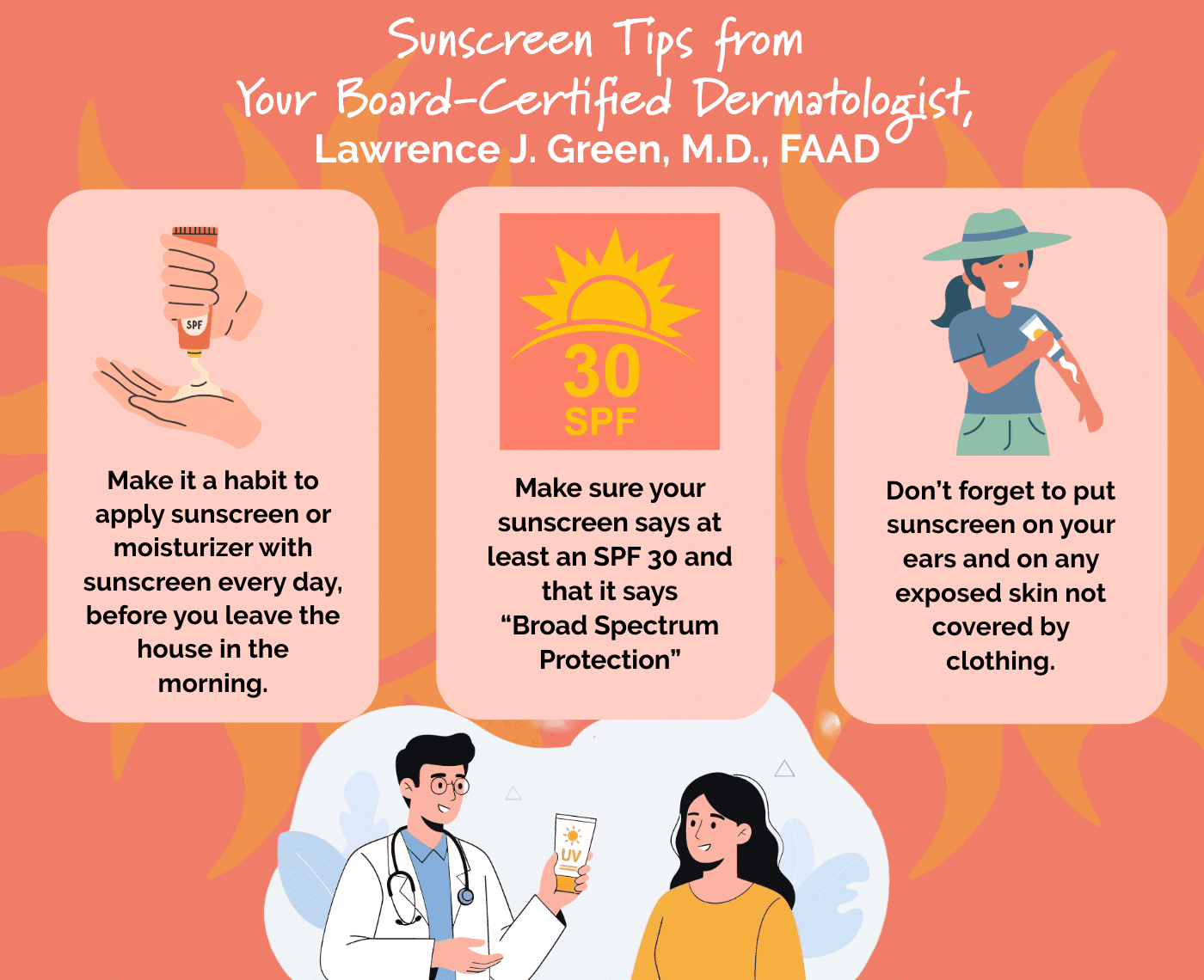
1. Make it a habit to apply moisturizer with sunscreen (or sunscreen) every day, before you leave the house in the morning.
I apply my moisturizer with sunscreen every morning after I shave. Another idea is to apply sunscreen every day before using your makeup (or you can apply a tinted sunscreen every day and you may not need additional makeup!) Always wait at least 15 minutes after applying any sunscreen to get in water or get wet. About one ounce of sunscreen is required to cover the entire body with one application (But you will use much about half an ounce if you are just applying it to unclothed areas of the face, neck, arms, and legs).
2. Make sure your sunscreen says it as at least an SPF 30 (for UVB radiation protection) AND it says “Broad Spectrum Protection” (for UVA radiation protection) on the bottle.
Both UVA and UVB sun radiation can cause wrinkles, irregular pigmentation, and lead to skin cancer. “BEMT” (Bemotrizinol) is a newly approved sunscreen ingredient that will be found later this year and into next year in sunscreen products in the United States. BEMT is special because it is a larger molecule (making it difficult to be absorbed through the skin and into the body) and is a very broad-spectrum ingredient, meaning it can stop almost all UVA and UVB radiation on its own from damaging your skin. Before BEMT, sunscreen manufacturers often had to have at least 2 sunscreen ingredients to give a similar broad-spectrum protection.
3. Don’t forget to put sunscreen on your ears and on any exposed skin not covered with clothing.
And use lotion, cream, or gel sunscreens-but preferably not sprays. Sprays do not evenly go on the skin when you spray it on (they can also go in your mouth when you spray your face), and thus can give you a false sense of protection when some areas of skin may have spray and other do not. Rubbing the spray in well after you use it (just like you rub in a lotion, cream or gel) helps provide more even sun protection.