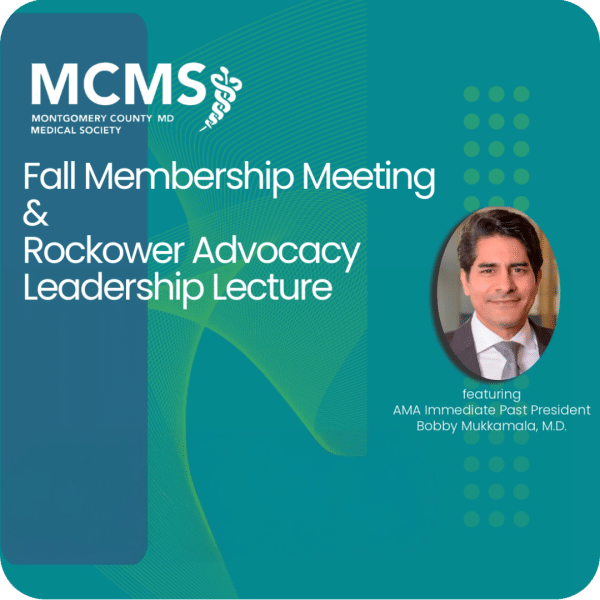
Fall Meeting Highlights Physician Advocacy and Leadership
MCMS held its Fall General Membership Meeting on October 21, featuring the second annual Stephen J. Rockower, M.D. Advocacy Leadership Lecture. MCMS President Dr. Alan Gonzalez Cota presided over the meeting, warmly welcoming former presidents, new members, and special guests.
The cocktail hour offered physicians a welcome opportunity to catch up with colleagues, make new connections, and enjoy a relaxed evening together. Lively conversation and laughter filled the room as members mingled, shared stories, and celebrated the sense of community that makes MCMS special. It was a lovely start to an evening of connection and camaraderie.
James Bryant, Executive Director of MCMS, noted “it was great to see so many physicians connecting with colleagues and our sponsors at the Fall Membership Meeting. Having opportunities to come together, catch up, and build relationships is an important part of maintaining a strong local physician community.”
A Look Back and a Look Ahead
Dr. Gonzalez Cota used his time at the podium to reflect on his first six months as president and share his vision for the Society. When he took office in April, he set out to strengthen advocacy for physicians and patients, make MCMS more valuable to its members, and build a more connected medical community across Montgomery County.
He thanked Mr. Bryant for stepping into the Executive Director role during a period of organizational change, following many years of dedicated service from his predecessor. Working with the Board, MCMS has been reviewing how it operates and serves members, with a strong focus on financial sustainability. “This isn’t simply about spending less,” he said. “It’s about making every dollar work harder for our members.”
He also spoke candidly about how isolating medicine can be, even for physicians surrounded by patients and staff all day. MCMS has been expanding networking events, educational programs, and outreach so that independent physicians, hospital-employed physicians, and residents alike see the Society as their professional home. On advocacy, he pointed to closer collaboration with MedChi and legislative partners, noting that “if physicians don’t participate in shaping healthcare policy, someone else will do it for us.”
He closed with a direct request for members to get involved by bringing ideas, inviting colleagues to join, and pushing MCMS to do better. “Physicians are pretty good at diagnosing problems,” he said. “Now it’s time to show we’re just as good at treating them.”
From Patient to Policy
The evening's featured speaker was Bobby Mukkamala, M.D., Immediate Past President of the American Medical Association (AMA), who delivered his lecture, "From Patient to Policy: Physician Leadership in a New Era."
Dr. Mukkamala opened with his own story, from his family’s immigrant roots to the brain cancer diagnosis that turned him from physician into patient. That experience reshaped how he sees the healthcare system, and he has kept leading through it. “As my life ran into the challenge of brain cancer, I had no idea that I would be able to continue to participate in our collective work,” he said, “but here I am.”
He then turned to the pressures facing American medicine. About 90 percent of the nation’s $5.3 trillion in annual healthcare spending goes to care for people with chronic and mental health conditions. Physician supply is not keeping pace with an aging population. Meanwhile, consolidation is squeezing practices and narrowing patient choice.
Falling vaccine confidence is showing up in real outbreaks. The U.S. declared measles eliminated in 2000, yet 2026 has already brought the most cases of any year since. In the last year alone, over half of states saw kindergarten vaccination rates decline.
He emphasized that the healthcare system needs meaningful reform and that physicians must play a leading role in shaping solutions. As he put it in his remarks, "Advocacy is a part of being a physician."
Dr. Mukkamala discussed several priorities for physician advocacy, including:
- Reforming Medicare physician payments to support sustainable medical practices.
- Tackling prior authorization and reducing administrative barriers that delay patient care.
- Stopping scope creep and supporting physician-led care.
- Reducing burnout and improving physician well-being.
- Advancing digital health, including artificial intelligence and telehealth.
National Advocacy Priorities and Progress
Adjusted for inflation, Medicare physician payment has declined 33 percent since 2001, and Dr. Mukkamala made the case for a system that offers financial stability and annual inflation-based updates. He pointed to the bipartisan Patients First Act in the U.S. House as the most significant effort in years to fix physician payment. The bill would reform budget neutrality, reward better outcomes rather than more reporting, and expand opportunities for physicians to take part in value-based care.
He also reaffirmed AMA policy supporting physician ownership and independent medical judgment, and opposing corporate arrangements that let non-licensed entities control the practice of medicine.
On the One Big Beautiful Bill Act, the AMA is pressing federal agencies to put patient access first as they write implementing regulations. It is also giving physicians resources on Medicaid work requirements and coverage changes for non-citizen residents to share with their patients. Separately, the AMA Litigation Center filed a brief in Massachusetts v. Oz, challenging a CMS rule that adds new paperwork for medically frail patients whom Congress meant to protect from losing Medicaid coverage.
Prior authorization reform is gaining ground. Dr. Mukkamala noted that 23 states enacted reforms in 2025 and at least 20 more bills are under consideration this year. The AMA also continues to push federal legislation, including the Improving Seniors’ Timely Access to Care Act. Physicians can join the effort at FixPriorAuth.org.
Dr. Mukkamala also noted the AMA’s support for the new federal dietary guidelines, which spotlight how highly processed foods, sugar-sweetened beverages, and excess sodium fuel chronic illness. The AMA has committed to expanding nutrition education for physicians and working with Congress on lasting nutrition policy.
These efforts show the importance of sustained advocacy at both the state and federal levels to protect physician practices, strengthen patient access, and improve the healthcare system.
Dr. Mukkamala's full presentation is available here.
Thank You to Our Members, Sponsors, and Partners
MCMS extends its sincere thanks to Dr. Bobby Mukkamala for an informative and thought-provoking lecture and for sharing his perspective on physician leadership and advocacy.
Programs like this would not be possible without the support of our sponsors and partners. We are grateful for their continued commitment to MCMS and our physician community.
Most importantly, thank you to our members for making time to participate, connect with colleagues, and engage in the issues shaping medicine. MCMS encourages all members to get involved through advocacy, networking, and community outreach as we work together to strengthen the profession and improve care for our patients.